Models and IDE agents
They reason, edit, and explain. They still forget local facts, repeat setup, and struggle when the repo's rules are implicit.
The current agent ecosystem gives us strong models, MCP transports, IDE copilots, CI, cloud APIs, and workflow engines. Those are necessary. They are not sufficient.
SmarterGPT fills the layer between model reasoning and real-world action: what the agent remembers, what the workspace exposes, what authority it has, which behavior rules apply, and how work is coordinated.
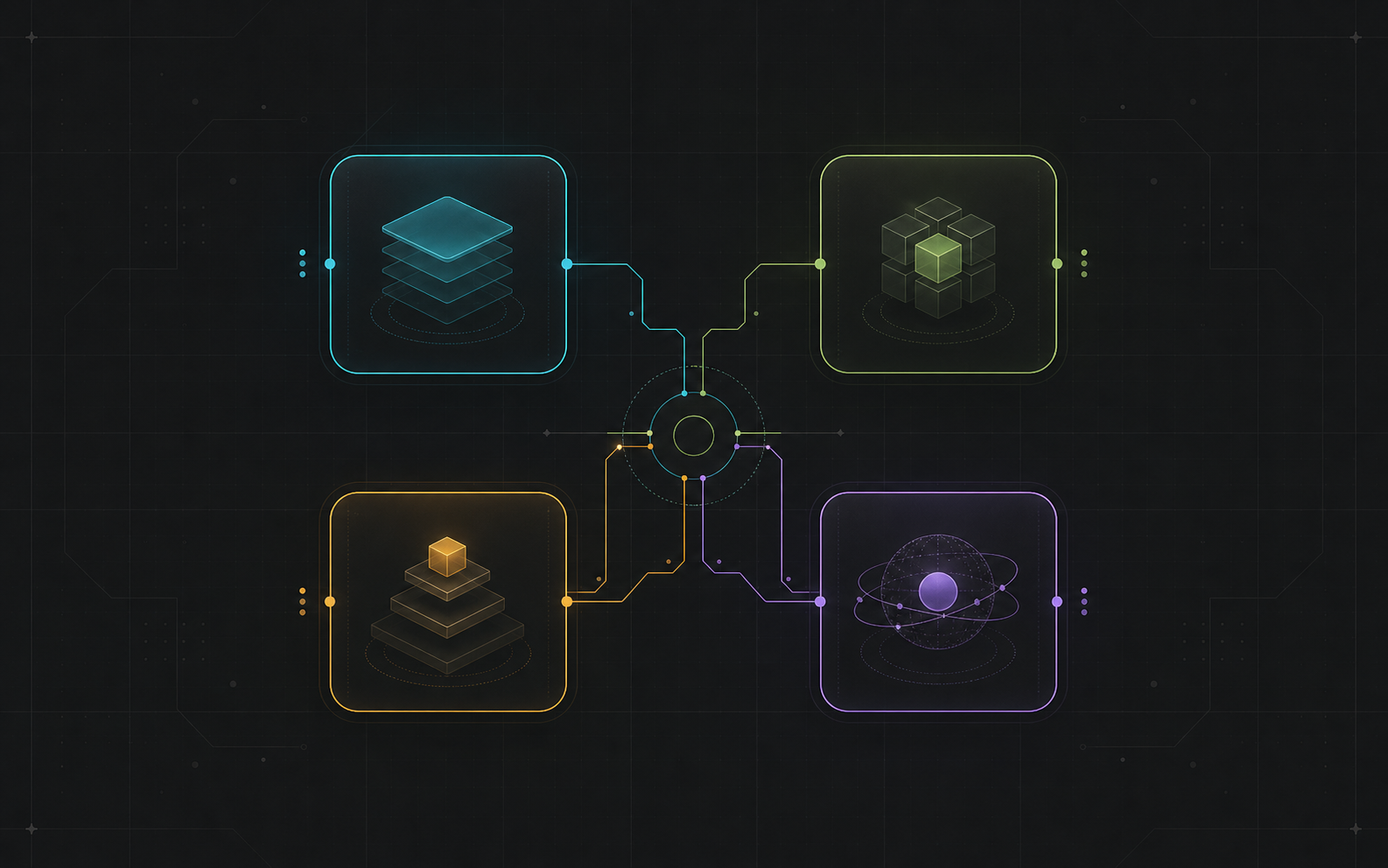
Most teams already have pieces of an agent stack. The problem is that the pieces rarely agree on responsibility.
They reason, edit, and explain. They still forget local facts, repeat setup, and struggle when the repo's rules are implicit.
They expose actions. They do not define which action is appropriate for this role, this credential, this workspace, and this risk level.
They enforce important boundaries. They usually report failure after the agent has already chosen an operation, not before it reasons about authority.
Agents need durable work memory that belongs to the workspace: what happened, why it stopped, which policy was involved, and what should happen next.
Every repo has its own build, test, search, diagnose, and release ceremony. Agents should discover those through a contract instead of guessing shell chains.
Role-like posture is useful, but the key question is effect-level: this agent, in this envelope, wants to do this operation. Is it allowed, denied, or escalated?
Personas should not be vibes. They should derive constraints that can be inspected, scoped, and declined when the right memory or confidence is unavailable.
Multi-agent work needs isolated execution environments, explicit gates, receipts, and deterministic plans so swarm behavior does not become unreviewable chaos.
| Layer | Current role | Status | Public surface |
|---|---|---|---|
| Lex | Memory, policy context, recall, instructions, local SQLite, CLI/MCP/API. | Public MIT. npm latest. | Project page / GitHub |
| AXF | Workspace-native capability declarations and execution surface. | Apache-2.0 source. See each npm version’s license. npm latest. | Project page / GitHub |
| ContextForge | Proposed deterministic context linking with inclusion, omission and provenance explanations. | Architecture only; ratification pending. No implementation or npm release. | Proposal page / Ownership decision |
| LexThority | Historical authority-boundary research: envelopes, effect decisions, escalation, and receipts. | Historical research; no active product commitment. | Historical research / GitHub |
| LexSona | Behavioral constraints derived from personas and learned rules. | Open source under Apache-2.0. npm 2.0.4 is public. Earlier versions retain their terms. | Project page / GitHub |
| LexRunner | Fan-out, gates, merge plans, contained execution, and swarm-style flow. | Open source under Apache-2.0. npm 2.4.0 is public. Earlier versions retain their terms. | Project page / GitHub |
LMV is the evidence-backed operational memory layer now being upstreamed into Lex and AXF. It makes the difference between remembered context and validated knowledge explicit.
| Precept | Stack behavior |
|---|---|
| Evidence is not truth. | Evidence references are typed witnesses, not final authority. |
| Memory is not evidence. | Frames can guide inquiry without pretending to close validation. |
| Recall is not certainty. | Agents verify current files, logs, tests, receipts, or runtime state before major action. |
| Uncertainty is part of truth. | Unknown, partial, stale, and invalidated states remain valid records. |
| Contradiction is signal. | Conflicting Frames link together instead of silently overwriting each other. |
| Forgetting is a feature. | Retention can expire, demote, supersede, or promote memory. |
| Assimilation must add distinctiveness. | Durable memory should change future behavior or prevent repeated work. |
| Provenance is dignity. | Claims cite files, commands, logs, receipts, commits, PRs, URLs, or upstream Frames. |
| Boundaries are consent. | Frames and capabilities state scope, data class, trust zone, and authorization limits. |
| Power requires audit. | Meaningful effects emit structured records with actor, scope, reason, result, and validation. |
| The operator remains sovereign. | Stop conditions and escalation protect destructive, secret-bearing, remote, or unbounded actions. |
| Failure under discipline is inquiry. | Failed bounded experiments can be preserved when their result changes future action. |
LexRunner should be able to spin up contained, worktree-like execution environments where agents can explore in parallel without sharing unsafe state or credentials.
LexThority is historical research with no active product commitment. Authentication and effect authorization remain separate engineering responsibilities, enforced by trusted hosts, identity providers and protected execution boundaries.
Different agents should operate with different posture and access: PM, analyst, developer, operator. LexSona expresses behavioral duty; the authority boundary is still being shaped.
Development is just the first domain because it has observable artifacts. The same operating stack applies anywhere agents touch tools under policy.
Separate PHI-sensitive memory, tool capability, credential reality, and escalation receipts instead of relying on prompt-only boundaries.
Agents can run known analysis capabilities, cite datasets and assumptions, and escalate when they lack authority to query or export.
Every attempted effect can become an auditable receipt: what was attempted, why it was allowed or denied, and which operator decision remains.